
For The Love Of Systems
When people ask me what I do for a living I always say the same 3 words:
“I build systems.”
And every single time, the reaction I get from people is the same. Confusion. Wonderment. And then a “What the hell is that ?” kind of look.
And every single time I think to myself, what approach will I use to explain it this time? How will I explain the most fascinating concept in existence. A concept that humanity and the average person doesn’t even know exists.
To say I’m obsessed with systems is truly an understatement. To the few who have had the “pleasure” of experiencing one of my system serenades, let me tell you, I know how to explain why systems are the most fantastic thing about life, if I can hold someone’s attention long enough for them to get through the actual explanation.
In order for you to understand why I think systems actually matter, we need to start at the beginning.
So What The Heck Is A System?
Simply put, a system is:
“A group of connected parts working together to create an outcome.”
That’s it. Everything we experience and enjoy in life is the outcome of a system.
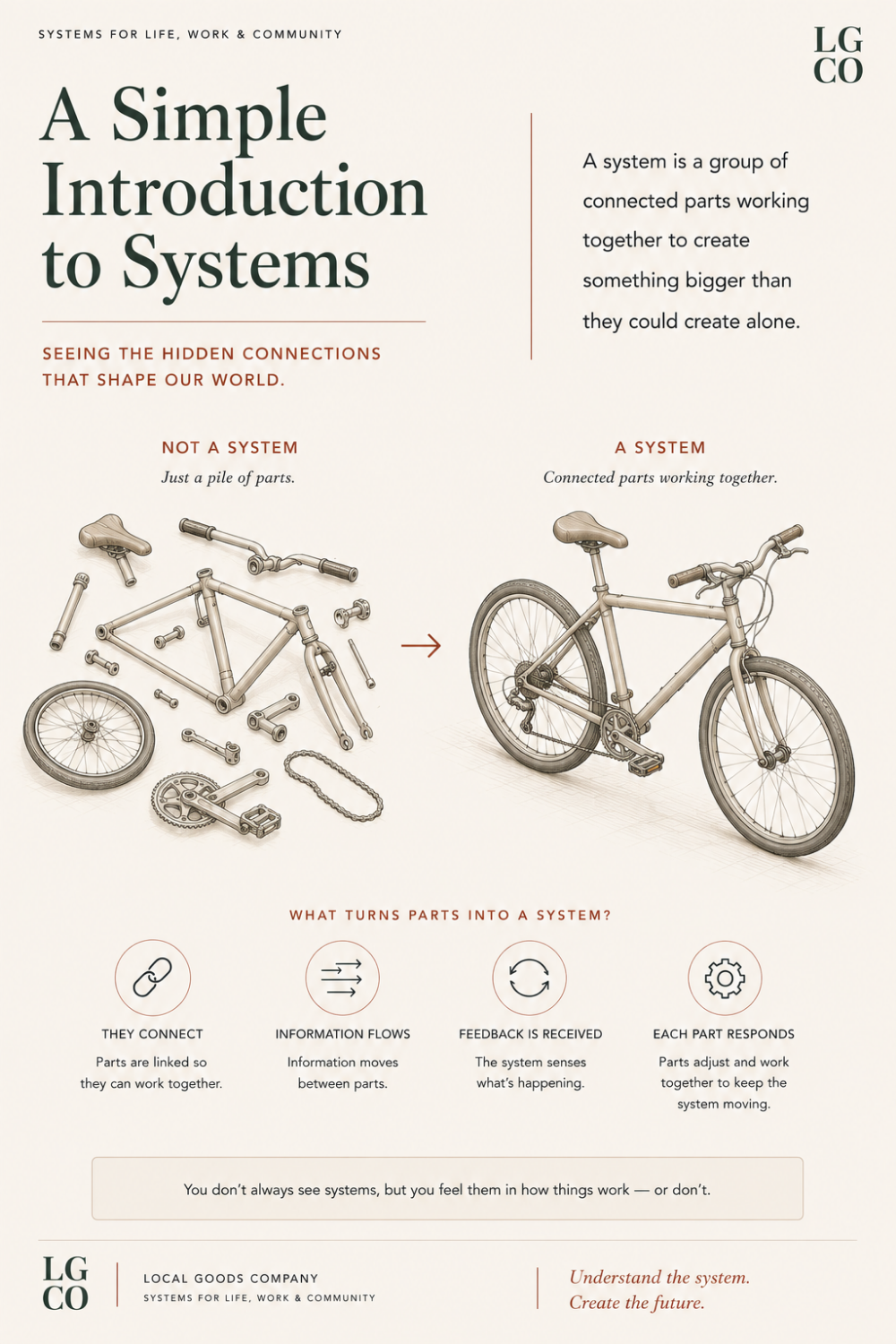
The reason systems are so powerful isn’t just because they contain parts, but because those parts communicate with one another. The relationships matter just as much as the pieces themselves. You can have every part needed to build a bicycle, sitting in a pile on the floor, but until those parts connect and work together, there is no system.
“Healthy systems communicate and are transparent.”
The health of a system depends on the quality of its connections. Systems fail when communication fails, which makes me wonder how many modern systems became fragile simply because we disconnected them from the natural principles they once mirrored or they never were connected to begin with.
One of the Most Important Systems In Your Life
Your home provides safety, comfort and stability, yet it is made up of many smaller systems working together.
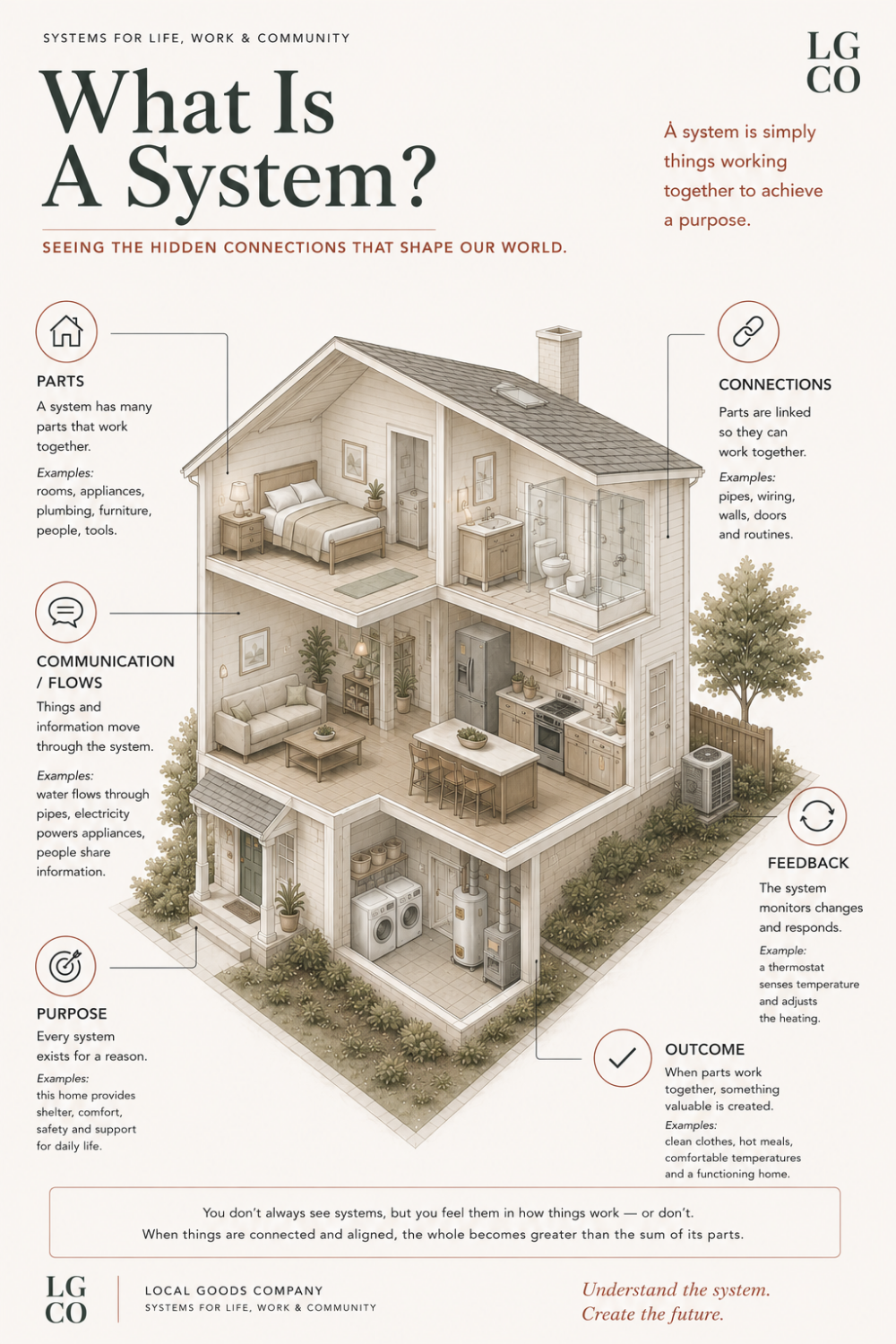
The plumbing system.
The electrical system.
The heating system.
The food system that keeps your fridge stocked.
The manufacturing and transportation systems behind the products in your home.
The routines and relationships of the people living inside of it.
At the same time, your home exists within larger systems such as, your block, your neighbourhood, community, economy and environment.
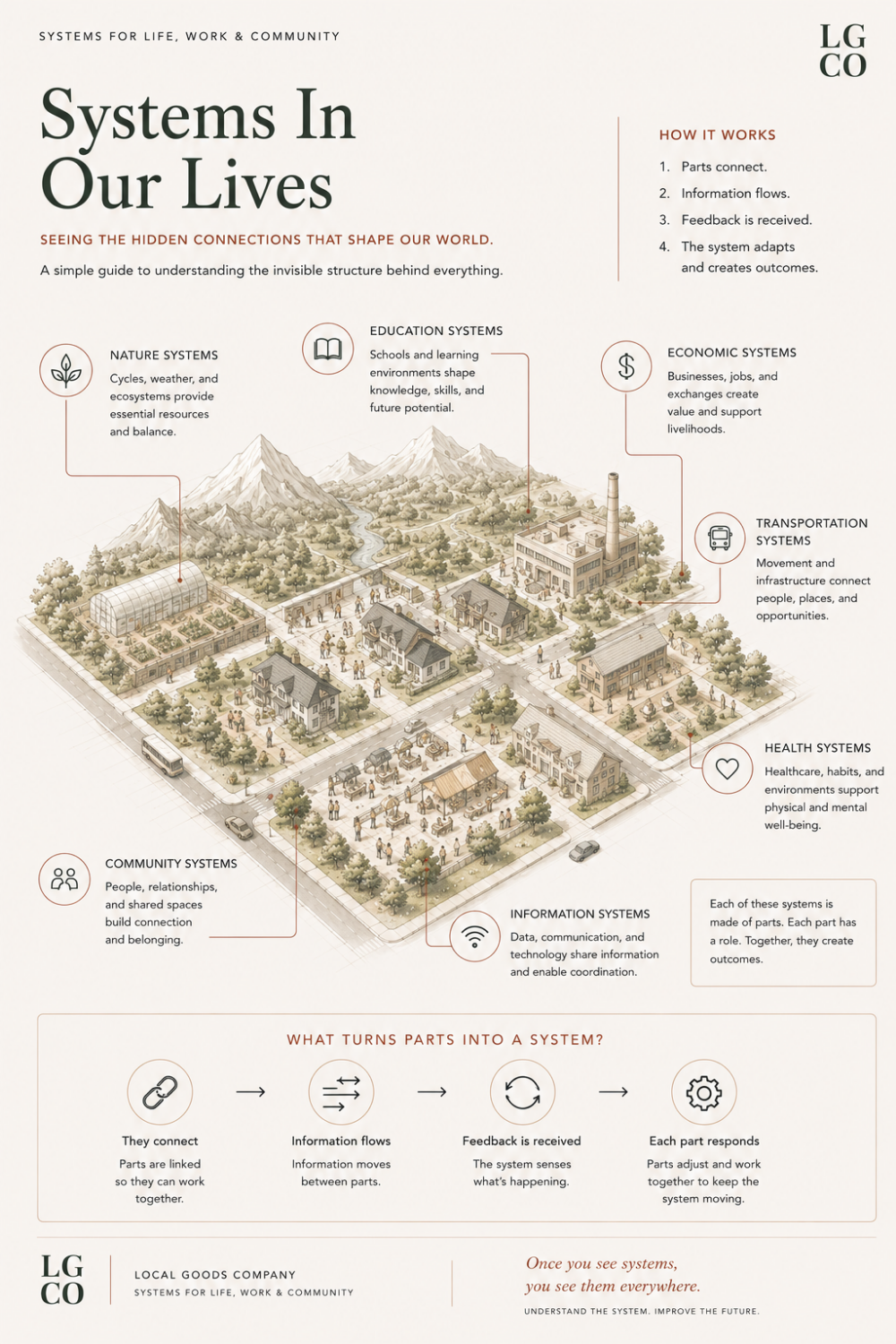
Once you start seeing systems, it’s hard to stop. You begin noticing them everywhere.
In businesses.
In communities.
In governments.
In your hobbies.
In your own habits.
I Accidentally Built A Career Around Systems
The funny thing is, I don’t think I intentionally became obsessed with systems. I think I slowly backed into them without realizing it, and the turning point came when I became aware they existed.
At the time, I was just taking whatever job I could get. I had no idea that each one was slowly teaching me how systems work.
My lack of stability and direction led me to work across farming, food distribution, certification, government-funded programs, health and safety, operations, finance, consulting, manufacturing and construction.
Every role taught me something different. Some taught me how products are made. Some taught me how teams communicate. Some taught me how businesses should operate. Some taught me what happens when the people making decisions are disconnected from the people doing the work.
Over time, I started noticing the same patterns everywhere.
The more systems I studied, the more I realized something. Most of the frustrations people experience every day aren’t random, they are the result of poorly designed, disconnected systems.
Looking back, this realization shaped my entire career.
I wasn’t only learning different industries, I was learning different systems.
What I Noticed
No matter where I worked, I kept running into the same frustrations:
We would take ten steps to do something that should have taken two.
We wasted time, money, resources and often people’s health.
The people closest to the work were rarely asked for their input, while the people making decisions were often disconnected from the reality of what was happening on the ground.
Everywhere I looked, I saw opportunities to make things work better.
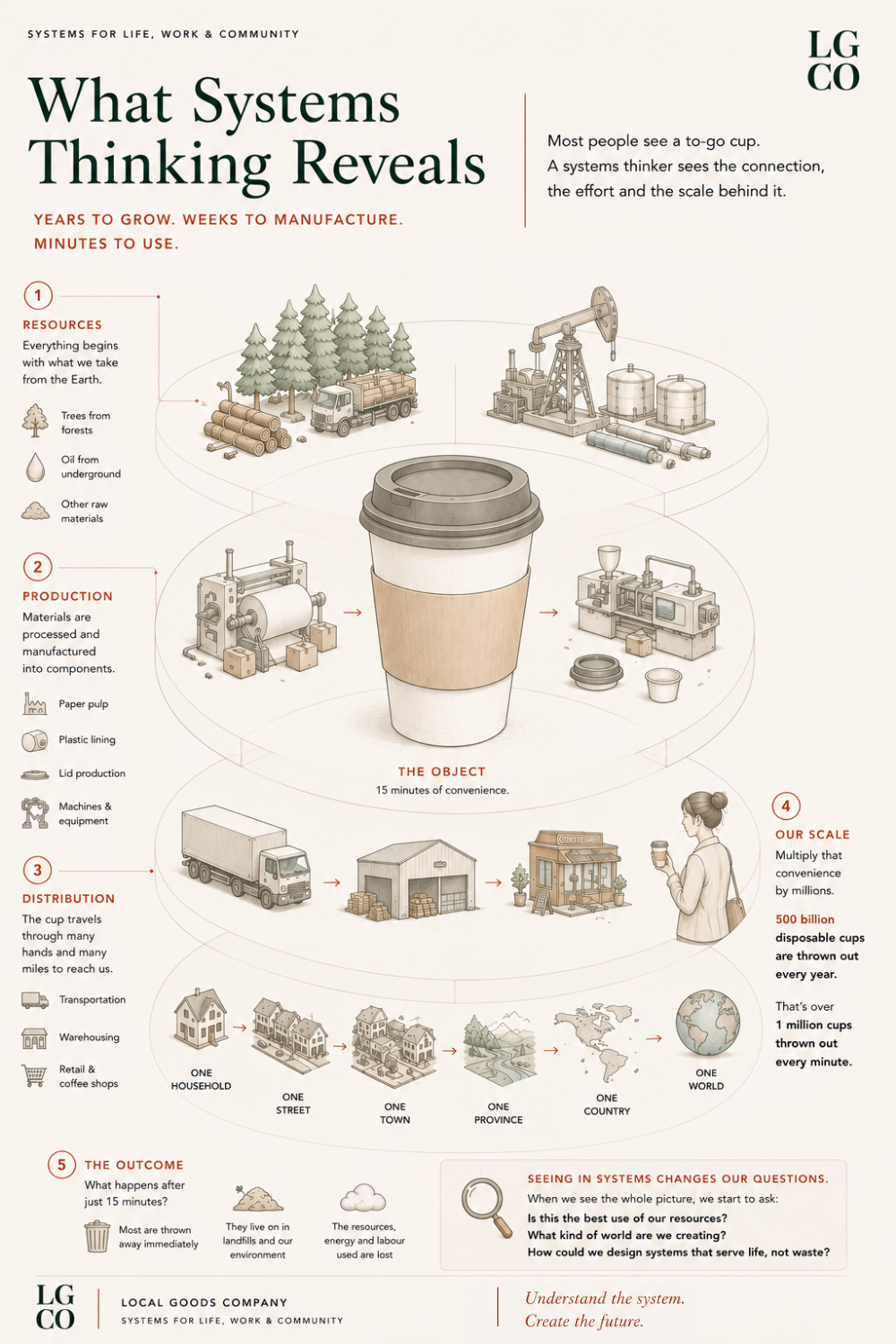
Even the simplest objects around us were often the result of enormous systems consuming energy, materials, labour and resources to produce outcomes that weren’t always aligned with what people actually needed.
Once I started seeing this, I couldn’t stop asking the same question:
Why are we doing things this way?
What Thinking In Systems Looks Like
A systems thinker sees the steps required to create anything we experience in the world.
Instead of complaining about things, what if we asked:
What is creating these outcomes?
Instead of focusing on individual parts, what if we looked at everything that has to happen to create the outcome we want?
How many steps did this take?
How much energy did we use to make this?
How many resources were consumed?
Why do we do it this way?
What aren’t we seeing?
What step is missing?
Why Should You Want To Think In Systems?
This is the exciting part! Systems can be changed and this is why everyone should care.
Most people spend their lives adapting to systems that don’t serve them.
They accept the stress, inefficiencies and frustrations as normal because they assume that’s just the way things are.
Yet many of the things we struggle with every day are often the result of poorly designed systems.
These outcomes don’t appear out of nowhere. They are usually being created by a system, whether we realize it or not.
But systems are designed by people.
Which means they can be redesigned by people.
Sometimes a small change can save time, reduce waste, improve communication and create better outcomes.
And if systems create outcomes, then better systems can create better outcomes.
Better systems.
Better decisions.
Better lives.
Over the coming months, I’ll be exploring the systems that shape our homes, health, finances, businesses, communities and the world.
My hope is that by learning to see systems together, to have people challenge my ideas and more importantly, to give feedback so we can start building better ones together.